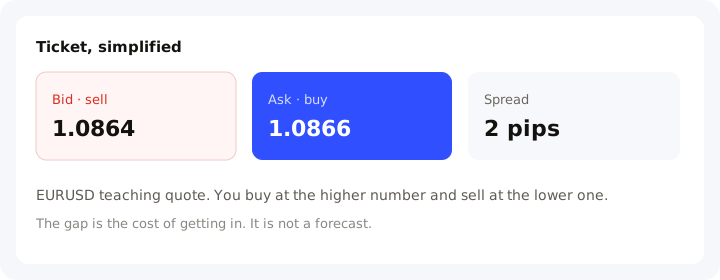
A forex trade is a bet on the price between two currencies, placed with a firm that shows you a selling price and a buying price at the same time. You do not collect a bundle of notes. You do not improve the exchange rate your cousin gets at a bank counter. You take a position that gains or loses as that quoted price moves, and you pay for the privilege in the gap between the two numbers.
You are not taking delivery
Say the pair is EURUSD. The euro is the base, the dollar is the quote, and the number tells you how many dollars one euro is being priced at. If the teaching quote reads 1.0864 / 1.0866, the market on that ticket is saying a euro is about a dollar and a bit. A rise in the quote means the euro is stronger against the dollar on that feed. A fall means the opposite.
Retail traders usually deal in contracts for difference or in rolling spot positions. The practical point is the same: your profit or loss is the distance the quote travels, multiplied by the size you chose, minus costs. Nobody is going to courier you euro notes because you clicked buy.
Two prices, on purpose
The lower number is the bid. That is where you sell. The higher number is the ask. That is where you buy. On the drawing above, buying EURUSD means paying 1.0866, and the position is immediately worth 1.0864 if you had to sell it back. The two-pip gap is gone before the chart has a chance to be clever.
This is why a strategy that needs a tiny move is often a strategy that needs a tinier spread than the one on the ticket. Look at the spread first. If your target is smaller than the gap you just paid, the idea is already tired.

Keep the bid and the ask in that order. You sell at the lower one and buy at the higher one. The homepage card shows a single teaching figure so the row fits. A real ticket will not be that polite.
The pip, which is just a digit
A pip is the unit traders use so they do not have to say "zero point zero zero zero one" all day. On most major pairs quoted to four decimal places, a pip is 0.0001. The teaching EURUSD move from 1.0864 to 1.0865 is one pip. Some platforms add an extra digit, a pipette, which is a tenth of a pip. Do not let the extra digit change your stop without you noticing.
USDNGN is often quoted with two decimal places, and on many tickets a pip is then 0.01. A move from 1,648.20 to 1,648.21 would be one pip. Your platform's specification wins over this paragraph if they disagree. Read the digit it multiplies, then come back.
A lot is a unit of size
Size is measured in lots because "some" is a bad instruction. A standard lot on a major pair is 100,000 units of the base currency. A mini lot is 10,000. A micro lot, 0.01 on the usual volume box, is 1,000. On EURUSD, one pip on a standard lot is about 10 dollars. On 0.01 lot it is about 10 cents.
Turn that into naira only with a rate you have chosen to treat as a teaching rate. At an illustrative 1,600 naira to the dollar, 10 cents is about NGN 160 per pip on 0.01 lot. If the dollar-naira rate you actually face is different, the naira figure moves with it. The size guide asks you to type the pip cost your own ticket shows, for this reason.
Margin and leverage
Margin is the deposit the firm locks while the position is open. Leverage is the ratio between the full size of the position and that deposit. At 1:100, a position worth roughly 100 units of account currency can be controlled with about 1 unit set aside, subject to the firm's exact formula. The unpaid 99 units have not become a gift. They have become speed.
A one percent move against a position that is levered 100 times is enough to erase the margin set aside for it, before spreads, gaps, and slippage. This is the mechanical reason a small account can vanish during a news minute. It is also the reason "the broker offers high leverage" is not a feature to be grateful for. It is a limit you have to set for yourself, lower.
What to carry into the next page
- You buy at the ask and sell at the bid.
- The spread is a cost on the way in, even when the chart looks still.
- A pip is a digit. Confirm which digit your platform uses, especially on USDNGN.
- Lot size decides how much each pip is worth. Leverage decides how little margin is required to hold that size. They are not the same knob.
If the pair you actually watch is the naira, the next page is the one that matters. Major-pair habits are a useful classroom and a poor map.
Long and short, without the costume
Buying is the easy verb. You pay the ask because you think the quote will rise, and you hope to sell later at a higher bid. Selling is the same machine run backwards. You deal at the bid first because you think the quote will fall, and you hope to buy it back later at a lower ask. You are not borrowing a suitcase of banknotes from a teller. You are taking a position whose profit and loss follow the quote. The firm handles the mechanics. You handle the size, and the size is where people get hurt.
Both directions pay the spread on the way in. A short is not a clever exemption. On the teaching EURUSD ticket, selling means dealing at 1.0864 while the buy-back price is already 1.0866. You start the same two pips behind. On the teaching USDNGN ticket the same idea is 5.20 naira behind, which is a different kind of behind. Direction does not shrink that gap. Only a different quote does, and you do not control the quote.
Where the profit is born
A pair's profit is naturally calculated in the quote currency, then translated into whatever currency the account is denominated in. On USDNGN the quote is naira, so the distance you capture is already a naira distance, multiplied by the contract size. On EURUSD the quote is dollars. An account that thinks in naira has a second conversion sitting inside the profit figure, and that conversion moves too. This is why a euro trade can look fine in dollars on a screenshot and feel different once it lands in an account funded from a Nigerian bank. Neither number is fake. They are answers to different questions. Write down which question the platform is answering before you compare it with a bank app.
None of this is a reason to prefer one account currency. It is a reason to stop treating the profit on the screen as if it were already spendable cash in the currency you pay rent with. Costs sit in between: spread, commission if the firm charges one, swap if you hold through the roll, and slippage if the fill is worse than the click. A back-of-the-envelope target that ignores them is a story about the chart, not a story about the account.
How long you meant to hold it
The ticket does not know whether you meant a minute or a week. You have to know, because the costs accumulate differently. A minute-long idea on USDNGN is often finished by the spread before the minute is. A week-long idea on the same pair may be finished by swap, even if the chart looks sleepy. A news-second idea on EURUSD can be finished by a gap that jumps the stop. Match the cost to the holding time before you match the indicator to the candle. If you cannot say the holding time in a single clause, you do not have an idea yet. You have a chart and a mood.
When the holding time, the spread, and the naira loss all fit on one line, you are ready for the size page. Not before. The lot is the last number, and it should feel slightly smaller than the one you first wanted.
The teaching ticket, worked in pencil
Take the frozen EURUSD numbers and refuse to improve them. Bid 1.0864, ask 1.0866. You buy, so you pay 1.0866. The chart may still be drawn through a midpoint, and the midpoint is not a price anyone promised you. If you planned to get out two pips higher, the bid has to reach 1.0868 before the trade is even flat on the spread, because you sell at the bid. A target written from the ask to a round number, without that step, is a target that spends its first part paying the toll. Do the same scribble for a short: you sell at 1.0864, and you are flat only when the ask comes back to 1.0864. The two pips are the rent for walking in. They are small on this pair and they are still not optional.
Now repeat the scribble on the frozen USDNGN ticket, bid 1,648.20 and ask 1,653.40. The distance is 5.20 naira. If your idea needed the quote to travel less than that before you would call it a win, the idea is a payment, not a plan. People meet this number and immediately look for a tighter firm, which is a fair errand and a different page. While you are still here, the job is to feel how wide 5.20 is next to a one-naira hope. Write both prices, subtract, and only then decide whether the picture on the chart is larger than the subtraction. The naira guide stays with that subtraction longer than this page will.
Keep the pencil version in the notebook for a week, next to whatever the live ticket says. When the live spread is kinder than the teaching spread, notice it and do not promote it into a personality. When it is wider, the teaching example was the optimistic one. Either way the method is the same: two prices, the direction, the currency the profit is born in, and the holding time. Leverage is still waiting at the end of the queue. It multiplies the result of this scribble. It does not fix a scribble that was already smaller than the spread.