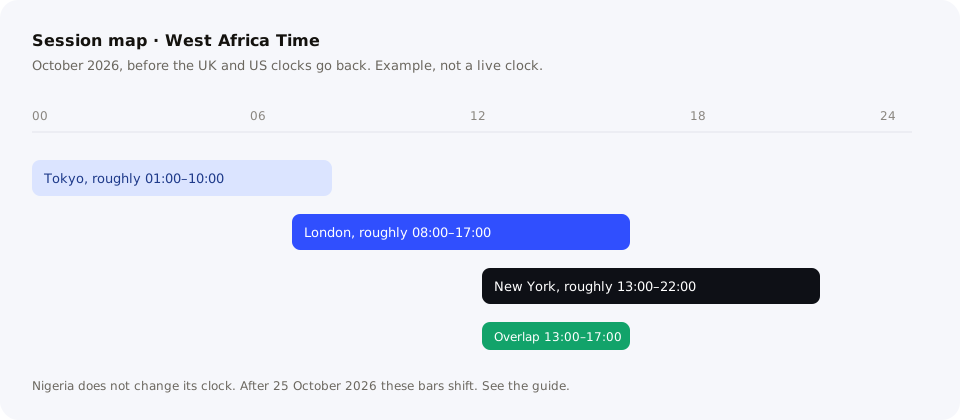
Forex is open somewhere almost all week, which is a polite way of saying you can lose money at 6 in the morning as easily as at 3 in the afternoon. Liquidity is not evenly spread across those hours. Spreads breathe. This page puts the usual sessions on a Nigerian clock, then admits where the foreign clocks move and ours does not.
Nigeria stays put
West Africa Time is UTC+1 all year. Lagos, Abuja, and Port Harcourt do not spring forward. When a guide from London says "8am UK time" it is not a fixed WAT time. In summer the UK is on British Summer Time, which is also UTC+1, so 08:00 in London is 08:00 in Lagos. In winter the UK is on GMT, UTC+0, so 08:00 in London is 09:00 in Lagos.
The United States moves on a different weekend. That single fact creates one awkward week most years. In 2026 the UK clocks go back on Sunday 25 October. US clocks go back on Sunday 1 November. Between those Sundays, London is on winter time and New York is still on summer time.
The clock as of 8 October 2026
Both the UK and the US are still on summer time on the day this page was updated. Traders usually treat the sessions like this. They are habits, not exchange bells. The cash forex market does not open with a gong.
| Session, roughly | In Lagos now | What changes in the room |
|---|---|---|
| Tokyo | 01:00–10:00 WAT | Quieter on euro and sterling. Yen pairs matter more. Fine for looking, poor for forcing a trade. |
| London | 08:00–17:00 WAT | The book thickens. Spreads on majors usually tighten relative to the Lagos night. |
| New York | 13:00–22:00 WAT | US data lands here. A second push of volume, then a long fade into the evening. |
| London with New York | 13:00–17:00 WAT | Often the busiest stretch of the day for EURUSD and GBPUSD. |
After the clocks change
From 25 October 2026, London's 08:00 becomes 09:00 WAT, and the London window runs about 09:00–18:00 WAT. Until 1 November, New York still opens near 13:00 WAT, so the overlap stretches a little, roughly 13:00–18:00. After the US change, New York's morning is about 14:00 WAT, and the overlap settles near 14:00–18:00 through the northern winter.
If you memorise one number and use it in February, you will be an hour early for New York and you will call the chart "dead" when it is merely not the hour you thought. Write the season in the corner of the notebook. It takes one line.

USDNGN does not owe you the London overlap. Majors usually breathe with London and New York. The naira can stay wide in the middle of that overlap because the book is local and thin. A busy euro hour is not a promise of a tight naira spread.
Rollover, when the spread yawns
Many retail platforms roll positions at midnight on their server clock. A common server sits two or three hours ahead of UTC, which often lands the roll around 22:00 or 23:00 in Lagos. The only authoritative minute is the one in that firm's swap schedule. Around it, spreads often widen, stops can slip, and a new day of swap is charged or credited.
Swap is the overnight financing on a leveraged position. It is not a wage and it is not a reason to hold a trade. On USDNGN it can be large relative to the movement you were hoping for. Read the figure in the platform before you leave a position open "just to see."
Scheduled punches
Some releases show up often enough to plan a coffee around them.
- US non-farm payrolls are usually the first Friday of the month, during the New York morning. In WAT that is early afternoon while the US is on summer time, and an hour later in the US winter.
- US inflation prints land in the same part of the day and move the dollar, which means they can move USDNGN even when nobody in Abuja has said a word.
- CBN policy days do not follow a foreign template. Check the Bank's own calendar instead of a reposted flyer.
You do not have to trade any of these. Standing aside for the minute of the number is a position. It is often the one with the smaller spread, because you are not paying one.
What to do with a quiet hour
A quiet hour is not a moral failing and it is not a secret strategy. Spreads are often wider, especially on the naira, and the candle looks informative because nothing else is happening. The useful work in that hour is preparation you can do without paying the spread. Copy the pip cost from the specification. Write the stop in pips and the loss in naira. Check whether London and New York are about to change clocks this month. None of that requires a position. If you are bored, boredom is cheaper than a trade you placed so the screen would feel occupied.
The Tokyo window, roughly 01:00 to 10:00 WAT in the October 2026 map, is a common place for this mistake. Euro and sterling are often dull. A reader in Lagos who is awake early can mistake that dullness for a coil. Sometimes it is a coil. Often it is a market waiting for London, and the spread is charging rent while you wait with it. If you cannot say why this hour should be kinder than the overlap, you do not have a reason to be in the trade. You have a reason to be awake, which is a different fact.
Monday morning and Friday afternoon
Monday's first hour can gap from Friday's last print. The stop you left on Friday is an instruction to a market that was closed. When it reopens, the fill can be worse, particularly on a thin symbol. If that worse fill would wreck the loss you sized, the position should not have been held. This is not a forecast that Mondays are dangerous. It is a description of what a gap is allowed to do.
Friday afternoon in Lagos often overlaps the later New York hours, when majors can still move and when traders start flattening so they do not carry the weekend. Spreads can widen as that happens, and swap is irrelevant if you are about to be flat, which is the point. Being flat into a weekend is a position. It has a cost of zero spread from that moment on. The size guide still applies to anything you insist on keeping: name the Monday gap as part of the loss, not as a surprise you will handle with courage.
A one-line habit
At the top of the notebook, write the month and the two opens you care about. In October 2026, before the clocks go back, that line can read: London about 08:00 WAT, New York about 13:00 WAT, overlap 13:00 to 17:00. After 25 October, change the London number. After 1 November, change the New York number. If the line is older than the season, you are trading a memory. The chart will not correct you. It will simply look quiet at the hour you thought was busy, or busy at the hour you had written off.
A sample afternoon, dated on purpose
Picture Thursday 8 October 2026, which is the date on these pages. The United Kingdom is still on British Summer Time. The United States is still on Eastern Daylight Time. Nigeria is on West Africa Time, as it is in January. London's cash open sits near 08:00 in Lagos. New York's cash open sits near 13:00. The overlap runs until about 17:00, and then New York's afternoon thins toward the rollover. None of those minutes is a bell that fires a trade. They are a map of when the book in front of a major pair is usually willing to deal. If your symbol is USDNGN, copy the map and then watch the spread anyway. A busy euro hour can still quote the naira as if the room were half empty.
Now move the same Thursday forward in your head to 30 October, after the UK has turned the clocks back and before the US has. London's open in Lagos shifts later. New York has not moved yet. The overlap is no longer the rectangle you memorised in summer, and a caption that still says 1pm to 5pm is describing a season that has already ended. One week later the US change lands and the rectangle moves again. This is why the page keeps two tables instead of one tidy slogan. If you only trade one of those seasons, write that season's hours and cross out the other so you do not mix them on a tired Friday.
The practical test is small. Before the session you care about, look at the spread on the symbol you actually hold, not on the symbol in the advert. If the spread is a large fraction of the move you need, the hour is busy for someone else and expensive for you. Standing aside is still available. It does not require a forecast about the rest of the afternoon, and it does not require you to be right about the Central Bank, the payroll print, or the cousin in the group chat. It only requires you to notice that the toll and the clock disagree with the idea.