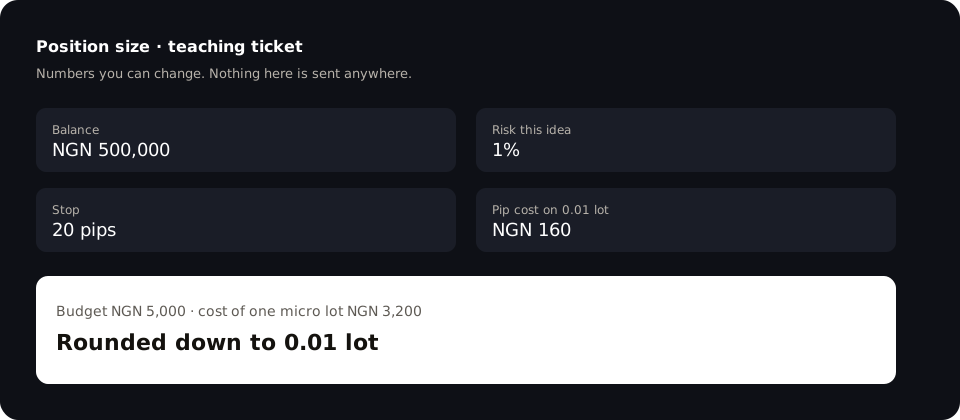
Most losing accounts are not undone by a mysterious candle. They are undone by a size that was chosen because it looked like a nice round lot. This page reverses the order. You name the loss in naira first. The lot is whatever falls out of that number, rounded down. If nothing falls out, you do not get to nudge the risk up so that a trade appears.
Name the loss before the setup
Pick a fraction of the account you can see hit, on a Tuesday, without it changing how you pay rent. Many careful traders use something around a half of one percent or one percent of equity on a single idea. That is a description of a habit, not a rule Hefi is issuing, and it is not a promise that one percent is safe. Five ideas in one afternoon can still add up to a wound.
Write the naira amount on paper. NGN 5,000 feels different from "1%". The percent is how you stay consistent as the account changes. The naira amount is how you stay honest.
The sum, with the working left visible
You need four inputs, and the fourth one has to come from your platform: how many naira a single pip costs on 0.01 lot for the pair you will actually trade. The 160 in the form below is the teaching conversion from the pair guide, about ten US cents at an illustrative 1,600 naira per dollar. If your specification says something else, type that. The form does not phone home. It only multiplies.
The steps, so the box is not a magic trick: budget equals balance times the percent. Cost of 0.01 lot equals stop distance times the pip cost. Divide the budget by that cost. Throw away the fraction. Multiply the whole number by 0.01. That is the volume. The unused remainder is not a failure. It is the point of rounding down. Rounding up is how a 1 percent rule becomes a 1.4 percent rule while everyone involved calls it discipline.
When the account cannot afford the stop
If the budget is smaller than the cost of 0.01 lot, the form will say so. The grown-up responses are dull. Shorten nothing about your life to fund a wider risk. Do not shrink the stop until it sits inside the noise and gets tagged every hour. Do not borrow the difference. Skip the trade, or study it on a demo where the loss is fictional and labeled as fictional.
A platform that offers micro lots smaller than 0.01 changes the arithmetic, not the order of operations. Name the loss, read the pip cost for that smallest step, then see whether the step fits.
Leverage is not a pay rise
The volume box and the leverage setting are different doors into the same room. High leverage lets a small deposit support a large position. It does not make the pip worth less. If you use the calculator honestly, you may notice you need very little of the leverage on offer. Leave the rest unused. A 1:500 badge on a website is an advertisement for speed, which is also an advertisement for how fast a mistake arrives.
Stops are not spells. In a fast print, a payroll number, or the minute around rollover, the fill can be worse than the line you drew. Size for the loss you want, and assume the market can charge you a little more. If that "little more" is unacceptable, the size is still too big.
A list to keep beside the ticket
- Balance, written down, not remembered from yesterday.
- Percent, then the naira amount it implies.
- Stop distance in pips, taken from the chart only after the invalidation is real.
- Pip cost from the platform specification, for this pair, at 0.01 lot.
- Volume rounded down. If it rounds to zero, no trade.
- No increase because the last trade won. The last trade is not a wage either.
Then, if you still do not know which button is the ask, go to the screen tour before you touch a live account. Knowing the sum and missing the button is how people market-buy while believing they placed a limit.
A second example, so the first one is not a charm
Leave the teaching defaults and change only the balance. Suppose the account is NGN 150,000 and the risk is still 1 percent. The budget is NGN 1,500. The stop is still 20 pips and the pip cost on 0.01 lot is still the illustrative NGN 160, so one micro lot loses NGN 3,200 if the stop is hit. The budget does not cover even one step. The calculator should refuse, and the refusal is the correct answer. Nothing in the chart's prettiness changes the subtraction. People in this spot often cut the stop until the arithmetic smiles. A stop moved to fit the account, rather than to mark where the idea is wrong, is not a stop. It is a smaller number in the way of the same hope.
Now suppose the balance stays at NGN 500,000 but you have two ideas open, each sized at 1 percent. The account is not risking 1 percent. It is risking something closer to 2 percent if both stops can be hit in the same hour, which is exactly what a dollar surprise can do to EURUSD and USDNGN together. Correlation is not a decoration for advanced readers. It is the reason the percent on a single ticket is not the percent on the account. If you cannot watch both, size as if you might have to.
After a winner, the sum does not get a raise
A green day is not new information about your character. The next trade still starts from the balance you have now, the percent you chose when you were calm, and a stop that belongs to the new idea. Raising the percent because the last click worked is how a method becomes a mood. The unused remainder from rounding down is not money you are obliged to put to work. It is the gap between a rule and a convenient lot. Leave it unused. The market will still be there when a later idea fits cleanly, and it will also be there if you skip the afternoon.
Write the result in a sentence you could read back on a bad Thursday: budget, pip cost, lot, and whether you rounded down. If the sentence does not match the ticket, the ticket is the one you paid for, and the sentence was a wish. Fix the habit on a demo before you fix it with a deposit. The risk disclosure is the page that says what leverage can still do after you have been careful. Careful is not the same as safe.
Why the remainder stays unused
The teaching case is still the one to check with a pencil. Balance NGN 500,000, risk 1 percent, so the budget is NGN 5,000. Stop 20 pips. Illustrative pip cost NGN 160 on 0.01 lot, so that step costs NGN 3,200 if the stop is hit. One micro lot fits. Two would cost NGN 6,400 and would break the budget. The unused NGN 1,800 is not a suggestion to tighten the stop until a second step squeaks in. It is the evidence that you rounded down. Platforms like whole steps. Your loss limit does not have to. Leaving the remainder idle is the entire point of the floor function, and a calculator that offered you 0.02 here would be doing you a favour you did not ask for.
Change one input at a time when you practise, or you will not know which change saved you. Shorten the stop and the affordable lot rises, which feels like skill and is sometimes just a stop that no longer marks the invalidation. Widen the stop and the lot falls, which feels like cowardice and is sometimes the first honest size of the week. Raise the percent and everything gets louder, including the loss you promised yourself you could sit through. If you change two inputs and then admire the new lot, you have hidden the cause. The page would rather you be slightly bored by a stable percent than impressed by a clever one.
When the arithmetic and the ticket disagree, believe the ticket and then find the disagreement. A wrong pip cost, a volume box left at 1.00, or a balance that still includes a deposit the bank has not cleared will all produce a confident wrong lot. The form on this page does not know those facts. It only multiplies what you type, and it refuses the trade when the smallest step does not fit. That refusal should be allowed to end the session. There is no remedial percent hiding underneath it.