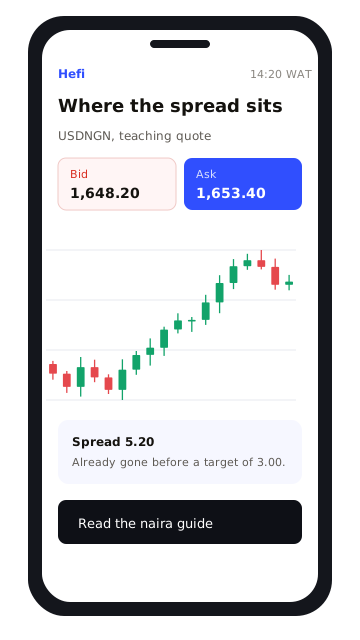
USDNGN is the pair a lot of Nigerian readers mean when they say forex, and it is a poor place to pretend that all pairs behave alike. The quote is a dollar priced in naira. Liquidity is thinner than on EURUSD. The spread is often wide enough to be the whole idea. And the number on a broker's chart is not obliged to match the rate at your bank, the Central Bank of Nigeria window, or the rate a friend quotes from memory.
Three rates, none of them universal
Keep the sources separate in your notes, or they will collapse into one imaginary "real rate" and every chart will look like a conspiracy.
- The platform quote. Bid and ask from the firm you trade with. This is the only rate that settles your position.
- The official window. Policy and published rates from the Central Bank of Nigeria. Useful for understanding policy. Not automatically the number on a CFD ticket.
- Any other rate you hear. A bank branch, a transfer app, a conversation. It may be real for that transaction and still irrelevant to the position on your screen.
Hefi will not help you deal outside the rules that apply to you. If a rate only exists off-platform, this guide stops. Moving money is your bank's business and the law's business, not a paragraph's.
What 5.20 of spread does to a small target
Use the same teaching numbers as the homepage, so the picture and the prose cannot drift apart. Bid 1,648.20, ask 1,653.40. You buy at 1,653.40. The position marks against the bid, 1,648.20. You are 5.20 naira underwater per dollar of size before the chart does anything you would call a move.
Suppose the plan was to catch a 3 naira bounce. The bounce you need, just to get back to flat, is already larger than the bounce you wanted. On EURUSD, a two-pip spread is often a nuisance. On this USDNGN drawing, the spread is the trade. Strategies copied from a major pair, especially scalps, die here in a way that feels like bad luck and is mostly arithmetic.

Write the spread on the same line as the target. If the target is smaller than the spread, close the notebook. The market does not owe you a thinner price because the setup looks neat.
What tends to shove the naira around
No calendar on this page pretends to know next Thursday. The categories are stable even when the dates are not.
- CBN decisions and circulars. The policy rate, FX rules, and the tone of monetary policy committee statements. Read the primary document, not a screenshot of a headline.
- Oil. Crude is a major export. A violent week in Brent can change how people feel about dollar supply, even when the link is not a neat formula you can trade blindly.
- Inflation and reserves. They shape the interest-rate gap and the story investors tell. They do not hand you a direction for a 15-minute chart.
- The dollar's own day. USDNGN can move because the dollar moved against everyone else. Check the US data calendar before you blame a local rumour.
A thin book exaggerates all of this. The same headline that nudges EURUSD by a few pips can shove a naira quote through the spread and keep going, or it can do nothing because the platform's price was never that tightly tied to the headline. Both outcomes are normal. Neither is a signal.
Use a major pair as the classroom
Learn the buttons on EURUSD or another liquid pair if you can, where the spread is a small slice of the move you are studying. Then come back to USDNGN with the spread written down. People who start on the naira often think forex is "too slow" or "rigged" when they are mostly watching a wide market in a quiet hour.
That is not a claim that majors are safe. A liquid pair can still gap through a stop on a payroll Friday. It is a claim about the quality of the lesson. If you cannot point to the spread on EURUSD, you will not interpret a 5 naira gap on USDNGN as a cost. You will interpret it as atmosphere.
How to look at a quote without inventing a story
- Name the source. Platform, bank, or policy window.
- Write both prices, not the single number a homepage uses to save space.
- Subtract. That remainder is the toll.
- Ask whether your target is larger than the toll by enough to be worth the wait.
- Only then look at the candle. The candle is not the first fact.
When the toll is acceptable and you still want a size, leave this page for the position-size sum. The naira does not get a special exemption from rounding down.
Other naira names on the same screen
USDNGN is the pair this page means unless it says otherwise, because it is the one readers open first. Platforms also list things like GBPNGN or EURNGN, and sometimes a synthetic cross that is two liquid pairs stapled together. Do not assume they share a spread, a pip, or a personality. A pound-naira quote can be wide for its own reasons, and a euro-naira quote can simply be EURUSD and USDNGN combined, with both spreads hiding in the price. If you trade the cross, write its own bid and ask. Borrowing the dollar-naira arithmetic is how a careful page becomes a sloppy ticket.
Oil, reserves, and the policy rate still matter as background, not as a button. A strong week in crude can change the story people tell about dollar supply. It does not entitle you to a direction on a fifteen-minute chart. The same is true of an inflation print. File the fact, then look at the two prices you would actually deal. If the spread ate the move you wanted, the macro story can be right and the trade can still be a bad idea. Those are allowed to be true together.
Quiet hours, weekends, and the gap you did not order
The naira book can be thin at the exact hour the euro book is busy. London's overlap is a clue for majors. It is only a rumour for USDNGN until you have watched that symbol's spread through the same hour more than once. Some afternoons the gap tightens. Some afternoons it does not, because the firm's price is a hedge of something else and not a deep local market. Trade the spread you see, not the spread you remember from a better day.
Holding through a weekend adds a gap risk that no stop fully cancels. The market you watch can reopen on Monday at a price your Friday line never traded. On a thin pair that reopen can be rude. If the position is too large to meet a worse price than the stop, it was too large on Friday. The session page covers the clock. This paragraph only adds the local warning: a quiet naira chart is not a sleeping major. It is often a wide quote pretending to be calm.
The payment and the chart are different errands
Understanding the quote does not move the money, and moving the money does not improve the quote. Your bank may block the card. The firm may take the transfer and still show you a spread that makes the idea pointless. Do those checks before you size anything live. Hefi cannot see the payment and will not ask for the receipt. If a rate only exists outside the platform and outside the rules that apply to you, this page still stops. We will explain the ticket. We will not help you go around a bank or a law to find a prettier number.
What to write down before you compare two naira rates
A reader can hold four naira numbers before lunch and feel as if they disagree. The bank app shows one. A transfer receipt shows another. The Central Bank's own page shows a policy fact with its own definition. The platform shows a bid and an ask that match none of them exactly. They are allowed to match none of them. Each one answers a different question, and the argument usually starts when someone averages them into a "real" rate and then blames the chart for missing it. Write the source next to the number. If you cannot name the source in five words, you do not yet have a rate you can trade or a rate you can cite.
The only number on this page that is allowed into a size calculation is the platform's own pip cost, read from that platform, on that symbol, at that hour. Our 1,648.20 and 1,653.40 are frozen so the subtraction stays checkable. They will not update when the market does, and a trade placed because they once looked familiar is a trade placed against a drawing. Refresh the firm. If the firm will not show USDNGN at all, that absence is information. It is a clearer answer than a homepage that only talks about euros and leaves you to discover the pair later, after the account is funded.
When the two prices, the source, and the hour are written, stop adding context. Oil, inflation, and the monetary policy rate can wait in a separate sentence so they do not leak into the volume box. Context explains why a quote might have moved yesterday. It does not shrink today's spread, and it does not choose the lot. If the spread is acceptable and the source is the firm that will settle you, the next page is the position-size sum. If the spread is not acceptable, the correct lot is zero, and the macro story can still be interesting. Interesting is free. The ticket is not.